Tuesday, June 21, 2016

Response 5

Teaching Brown Girl Dreaming by Jacqueline Woodson (2014)
            Teaching poetry in the classroom is not an easy task as many kids struggle with understanding this art form if they try to engage with it at all. Brown Girl Dreaming provides a great text for teaching poetry because it is in narrative form. This biographical poem tells a story and students who would normally pushback and struggle with studying poetry can easily comprehend the events within the plot. The free verse of Brown Girl Dreaming allows the study of its poetry to focus on certain techniques – such as alliteration and line-breaks – rather than focusing on constructed form filled with metaphor and allusion. For those students who struggle with studying poetry, Brown Girl Dreaming in narrative free verse is comprehensible yet poetically complex and is an excellent poem for these students to examine.
            Initially, to approach Brown Girl Dreaming as a story is to approach this poem on familiar ground for students who resist examining poetry. Get them interested with what their familiar with. Brown Girl Dreaming is filled with universal themes that students will be able to relate to. They should also be quite familiar with discussing theme in narrative. One theme this poem explores questions how one understands their childhood and where they come from. Woodson struggles with the idea of home moving from Ohio to South Carolina with the long-term goal of possibly moving to New York. This theme is not hidden away in metaphor or allegory for students to dig to find the treasure. It exists in the larger narrative of the story. After introducing the themes through familiar questioning, teachers can then approach the emotion, rhythm, and free form in the poetry. The poems entitled “our names” and “ohio behind us” are two good poems to discuss the theme of home and how Woodson struggles with it and to inspect some of the rhythm and emotion of the verse.
After discussion of the theme of home that Woodson struggles with the teacher can move to discussion of how this struggle is developed in the poetic voice. In the poem “our names” we see Woodson emotionally negotiating this transition. “In South Carolina, we become” (45) is the first line, then a list follows. In examining this stanza, we must first examine the form. With this first line we see how Woodson struggles with identity after their move from Ohio to South Carolina. The first line breaks at the question “we become” what? Become is a word in transition; become connotes a transition between then, now, and the future. Just as the children are physically in transition they are in identity as well.
The following lines answer with a list of all the different names the children are called: “The Grandchildren / Gunnar’s Three Little Ones / Sister Irby’s Grands / MaryAnne’s Babies” (45).  The various names they are now called are new and different just as the place they move from and to. How these names are listed each to their own line, and italicized, objectifies the names as if Woodson does not yet know which one she can relate to. Here, as elsewhere, Woodson uses italics to voice another person’s words. These are others’ names used for them, not their own and no longer individualized. Students should not struggle too much with analyzing the form of this first stanza and feeling the emotion of anxiety it creates.
The second verse of this poem has a more accepting tone and develops towards individualization and love: grandmother calls them “HopeDellJackie” all their individual names grouped together. The progression of this stanza then leads to “but my grandfather / takes his sweet time, saying each / as if he has all day long / or a whole lifetime” (45). Finally, they are “each” their individual selves again. “Each” hanging off line 11 of this poem places emphasis on the word and what it connotes. The rhythm slows down, the grandfather “takes his sweet time.” The anxiety of the first verse loosens up and by the end of the second verse there is acceptance of this change. For students who have difficulty discovering the dynamics of poetry through interpretation of structure, investigating a known theme of the text through its interpretation of the poetry should be easier for them to apply analytical skills to poetry. Connecting this poem to the one that follows, students can further examine how emotion is portrayed through form and they can connect the struggle with identity to that of home.
“ohio behind us” is the second poem in part two, after they break from their father and move to South Carolina. This poem discusses the theme home, and expresses again the emotion of anxiety. As with the first poem “our names” there is no metaphor or difficult structure to unpack in order to find some beauty of the verse. This aspect of the poem will allow students who struggle or fear analyzing poetry to approach it with teacher guidance. For these students, the teacher could approach this poem by discussing the theme in context of the larger text. How is home troubling to Woodson in this specific transition in her life? This approach is the same you would use for prose. Taking another step closer to the poem, read the poem aloud. As with “our names” the rhythm of this poem reflects the emotion of the experience. By suggesting this before the reading, you can ask students what emotions does this poem reflect in listening to and feeling its rhythm. When spoken the first stanza should be heard as the run-on sentence it is. This form points to the subject matter: “When we ask” the answer “mother” gives is uncertain and non-definitive because “she doesn’t know how long we’ll stay” (46). Like a parent trying to figure it out, she speaks in circles never landing on a definitive answer. This rhythm is repeated in the second stanza, also indicated by the parallel “When we ask” and the parallel structure of a run-on sentence. However, mother has a consideration of “to the North” for an answer, the relatively short line 10 of the poem. If these two stanzas are read as Bucher and Hinton suggest: “by reading slowly in a normal tone of voice and pausing at the punctuation, rather than at the end of the line” (308) students should feel the slight difference between the two. The second stanza has more commas, more pauses, more room for consideration. The anxiety from the first stanza to the second lessens as mother considers moving to the North. The volume – the amount of words – the energy, the rhythm of the first two parallel stanzas gives a lot of weight to the final three stanzas which are much slower and shorter; it’s as if the energy slows to rest heavy on the next three stanzas. This poem ends with the heavy realization that “home / isn’t really coming back home / at all” (47). The energy from the rhythm of this poem indicates the heavy emotional experience Woodson has as she contemplates this transition in her childhood. In reading this passage aloud students should be able to hear the energy and rhythm and begin to understand the emotion behind these words.
To approach this text as a narrative form providing themes the narrator struggles with, and then to approach the aspects of the verse should make it easier for students who struggle with and resist poetry analysis.
Works Cited
Bucher, Katherine and KaaVonia Hinton. Young Adult Literature: Exploration, Evaluation, and Appreciation. 3rd Edition. Boston: Pearson, 2014. Print.

Woodson, Jacqueline. Brown Girl Dreaming. New York: Penguin Group. 2014. Print.

Monday, June 20, 2016

Teach This Response # 3 - Biographical text

The Notorious Benedict Arnold

Summary of the Story

          This is the biography of Benedict Arnold VI, and its secondary title lets the reader know what’s to come: a true story of adventure, heroism and treachery. The story begins with a public execution, and then arcs back in time to Arnold’s birth on January 14, 1741. Following his life in short, concise chapters, The Notorious Benedict Arnold has a reader run the gamut of emotions about him: sorrow at the loss of several of his siblings (including an older brother who had also been named Benedict); alarmed at the descriptions of his childhood antics (he is referred to as both a “daredevil” and “a bright boy, so full of pranks and plays” (Sheinkin 7)); anger at his father (by most accounts, Arnold IV was a drunkard who squandered the family’s modest fortune); and, numbness and disbelief at his betrayal. From his days at school to his apothecary apprenticeship to his accomplishments as a colonel (and later, as a major general) in the Continental Army, Arnold’s biography reads like a straight-up tale of adventure, especially as you study the chapters which detail his brilliant military career. He was severely wounded at least twice and almost lost his leg as a result. He won the admiration of General Washington, who wrote, “The merit of this gentleman is certainly great. I heartily wish that fortune may distinguish him as one of her favorites” (Sheinkin 102).
Arnold was his own worst enemy, in many ways. His bluntness rankled members of the Continental Congress, who grew increasingly concerned that American military leaders were gaining in celebrity (Sheinkin 147). When Washington submitted a list of names to Congress for promotion (Arnold, among others), Congress chose to ignore Washington’s suggestions. Washington, both a general and a statesman, knew the quagmire he’d step into if he argued the point. Arnold, however, took it as a personal insult (Sheinkin 148). He is quoted as having said that he knew “. . . some villain has been busy with my fame, and busily slandering me” (Sheinkin 149). It would not be the last time Arnold would rail against what he saw as disrespectful attacks on his character and good name.
His idea of wooing was as bombastic as his battlefield skirmishes. After his first wife dies at the age of thirty, Arnold is left with three small boys to raise. In one instance, he meets a young woman at a party, talks with her all evening, and then has a trunk filled with expensive gowns delivered to her shortly thereafter (Sheinkin 146). The lady rejects his advances. At the same time, his business is suffering as a result of his absence, as well as the war. You begin to feel sympathetic toward Arnold – trial after tribulation, Arnold is kicked backward. (I can only say what I felt: even though I knew the end of the story, I still held out hope that he’d see the error of his ways.)
Enter British occupational forces and Major John Andre, another interesting and charismatic personality. Andre’s military career took him to much of the New World between New York and Quebec. He quickly rose through the ranks, becoming General Henry Clinton’s closest aide and chief of intelligence (Sheinkin 223-4). It was while he was in Philadelphia, however, that Arnold’s story and his begin to intersect. Andre meets Margaret “Peggy” Shippen, the same Peggy Shippen who would later become Benedict Arnold’s second wife. As I read Andre’s description, I couldn’t help but compare him to Arnold - they both share a vanity of nature. One senior officer even referred to Andre as “a cringing, insidious sycophant” (Sheinkin 224). Andre, aware of his fellow officers’ resentment, decided to use his intelligence position to “. . . pull off something big” (Sheinkin 224). Andre should have read the story of Icarus.
Set against the historical framework of the American Revolution, The Notorious Benedict Arnold quickly reaches its crescendo – and you realize who is at the end of the gallows rope in Chapter One.

Why Teach This Text

           There are many reasons to recommend this text to educators and students alike. First, the book recounts the life of a man whose very name has become synonymous with the word “traitor,” and yet that is only part of the story. His military exploits have sadly been totally overshadowed by his one treasonous act. Had Arnold been able to overcome his temperament, his name would have been whispered in reverence, alongside other heroic figures of his day. More than once his actions on the battlefield saved the nation in its infancy. A genius at strategy, his fleet of fifteen small ships engaged the larger and far superior British fleet at the Battle of Valcour Island. His tactics kept the War of Independence alive (140). He is a fascinating character and, as Sheinkin writes, multifaceted: intelligent, hard-working, and ferociously determined (13). Yet, he was a reckless show-off who respected authority when it suited him, and whose explosive temper could be sparked with the merest of slights. Those traits, as Sheinkin says, made “. . . an explosive mix” (13). Arnold was a man at war with himself; what a shame the Revolutionary War wasn’t enough for him.
          His biography reminds us that he was a real person, a human being, with all the flaws and foibles that come with that. This is one reason we study history – to flesh out the person and to realize that he or she is not just a footnote, a line on a tombstone or a paragraph on a road marker. They’re no longer two-dimensional. You marvel at Arnold’s bravery; you condemn his inexcusable choices. You mourn the loss of his wife; you wince at his avarice. One thing you do not do is forget him.
          In addition, his biography is well-written and well-researched. I believe that this book will make students want to learn more about the Revolutionary War in particular, and hopefully, about history in general.
          It is also worth mentioning that Sheinkin’s work does double duty: it tells a story, but it makes the reader think. I found myself asking just how complicit was Peggy Shippen in her husband’s plot to hand over West Point, as well as the capture of General Washington. She is described as interested in politics, business and the law (her father was a prominent judge); she read his books. Peggy Shippen, as Sheinkin writes about her, does not seem the type to be a passive participant in her or even Benedict’s life (195).
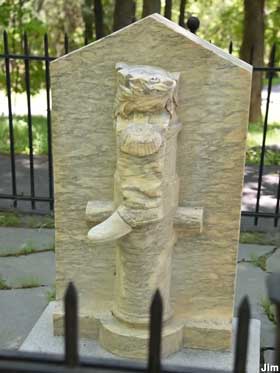
          Other themes that may be examined: greed (Arnold was not the only person who suffered financial loss during this time, yet he succumbed – why?); pride – something that he and Andre shared, and both to their detriment; and, betrayal – Benedict Arnold committed treason, but he also betrayed those closest to him (most especially General Washington). In Saratoga National Historic Park, there rests a monument to Benedict Arnold's leg. It sits on the spot where Arnold fell wounded during the Battle of Freeman's Farm. As the story goes, Arnold leads a raid on Richmond, wearing his new British uniform. Several American soldiers were taken prisoner in the raid.

Arnold asked one of the prisoners what he thought the Americans would do if he, Arnold, were ever captured. “If I must answer your question, you must excuse my telling you the plain truth,” said the prisoner. “If my countrymen should catch you, I believe they would first cut off that lame leg, which was wounded in the cause of freedom and virtue, and bury it with the honors of war; and afterwards hang the remainder of your body.”  (Sheinkin 301)


The book, albeit an easy read, bears several of the features which Bucher and Hinton consider worthy of a good biography: it is an authentic biography, told in an objective manner that is both even-handed and relevant (259-60). It was the 2012 winner of the YALSA Award for Excellence in Nonfiction for Young Adults and the Boston Globe/Horn Book Award for nonfiction. It is, in a word, gripping. It definitely deserves a place in your curriculum.

Activities/Assignments/Prompts

  1. Have students write a eulogy for Benedict Arnold, as though President George Washington had been asked to speak at Arnold’s funeral
  2. “Pride goeth before a fall.” Discuss why (or why it isn’t) applicable to Benedict Arnold’s life choices
  3. Which of the other people in the book would you like to meet, and why?  (e.g., Henry Knox, Peggy Shippen, Alexander Hamilton)
  4. Find a book (keep in mind, that it should be a common or easily-obtainable book) and create your own secret code
  5. If Arnold’s treasonous acts happened today, it would be a huge news story. Say you’re a reporter – come up with about ten questions that would you ask of General Washington
  6. In the same vein, given the scenario in # 5, who would you most like to interview? Come up with ten questions for that dialogue
  7. Again, given # 5, this time you’re the photographer – what photos or other media would you use to tell this story. Put together ten to twelve items in a portfolio, along with captions
  8. Create a timeline of important events in Benedict Arnold’s life that you think molded him and provide a short summary (a sentence or two) as to why you chose those events
  9. Conduct an internet search for Benedict Arnold; locate five images that you think best represent the physical description of him. Cite your sources
  10. With the help of any mapping app or tool, plot the battles in which Benedict Arnold was a participant. Write a paragraph to summarize each battle and his role in it

Works Cited


Bucher, Katherine, and KaaVonia Hinton. Young Adult Literature: Exploration, Evaluation, and Appreciation. 3rd ed. Boston: Pearson, 2014. Print.

Sheinkin, Steve. The Notorious Benedict Arnold: A True Story of Adventure, Heroism & Treachery. New York: Roaring Brook Press, 2010. Print.


Emily's Teach This Response #3


Teach This Response #3

The book I chose is called Assuming Names and is a book based on the true story of a 15 year old con artist (in 1985). The book is about a 15 year old girl named Tanya who ran away from her home in Tennessee planning to go to Dallas. Growing up she had on many occasions faked an accent, pretending to be older than she was, and many people fell for it. Therefore she decided that she could easily runaway and pretend to be a countess, so she took money from her parents safe, dressed the part and started on her way. She hitched a ride from a police officer. With her fake accent, and lying skills she convinced him she was a countess who had a fight with her husband and got out of his car. Therefore, leaving herself stranded on the road with only the cash in her purse. She was then transported to another station where she con-ed more officers before getting in a cab and leaving. Arriving in Dallas she continued her charade. Accidentally implying that she was a sex slave being trafficked, being 15 she didn’t understand why they thought this, or what they were insinuating. We follow her on her journey and quest to be known as a countess watching her fool everyone. She encountered the FBI, Interpol, the DEA, INS, 12 psychologists and psychiatrists, the ACLU, a couple of sheriff departments, some celebrities, and fooled them all. Eventually when the charade is up we will follow her adventure as a con artist growing up. We will follow her adventures, pain, and troubles with her love life. This book is extremely interesting and attention getting, and the fact that it is real makes it that much more crazy and unbelievable.

I will be teaching this to a high school class, and I believe there are a lot of interesting lessons to learn within this text. We see Tanya’s trouble with identity which I can make relate directly to my students. All students struggle with who they are, and this is a dramatic way to show the struggle. Whereas for most this is a struggle inside people’s minds, the struggle for Tanya was more outward. The book also shows us the importance of the truth, and the trouble lies can get you in. But, on the other hand it also shows that it’s wrong to be brutally honest. Sometimes if you love someone you have to give a little white lie. The problem is figuring out when its acceptable and when it’s not to lie. Where is that line?

Along with all the themes that can be used to be taught I believe the fact that its nonfiction is important as well. Most students and people in general, me included, don’t like the idea of reading a nonfiction book. The reason being that we see them as something that will probably bore us, because its “real life.” I believe this book will change students opinions on that matter. The book is interesting and full of adventure, with some love, and many shocking events. Yet it’s about a real person that actually lived and went through all of this. Many kids probably won’t believe it’s true because of how interesting, and captivating it is. Yet right in the beginning of the book are the words; “This is a true story. (13)”

I think there are many activities that can be used in a classroom to teach this book. One of my favorites is to create a new cover, after reading the book. The cover is always the thing that catches young readers eyes, so it makes sense to have students re-imagine it. Another activity would be for students to draw out or write out how they deal with their identity struggle. Whether this is in an essay, poem, song, or picture, they can find a way to express themselves. The last activity I will list would be an essay question, I would give them several prompts to choose from. One could be: What do you think Tanya should have done differently? Pick a situation and write about it.


References

Thompson, Tanya. Assuming Names: A Con Artist's Masquerade. South Carolina: Smashwords, 2014. Print.


Sunday, June 19, 2016

Teaching Between the World and Me by Ta-Nehisi Coates (2015)
            Between the World and Me by Ta-Nehisi Coates is an epistolary biography to his fifteen-year-old son about what it means to be a black man in a black body in urban America. The first part is a biographical account of Coates’s youth in West Baltimore where he learned the black body carries the burden of the constant plundering and destruction of it. As a young man he attends Howard University where “the history, the location, the alumni combined to create The Mecca – the crossroads of the black diaspora” (40). At the Moorland-Spingarn Research Center at Howard he dives into an independent study of African-American identity, and he develops interrogation, writing, and poetry skills through these informative years. The second part of the letter speaks to the very personal crisis of police brutality when his friend Prince Jones is killed in Virginia by a black undercover Prince George’s County cop. Coates discusses the several cases of racial profiling and abuse of police power that have ravaged America over the last few years and how that burdens the black body. With the third and final part of this letter Coates finds some peace and acceptance after he speaks, years later, and at length to Prince Jones’s mother. The letter ends with some hope and reconciliation through love and identity for what it means to be a black man inhabiting a black body in today’s America.
            This non-fiction biographical epistle would be an excellent text to teach in 11th or 12th grade English literature class and/or an AP class. This text is considered young adult in that it is a letter addressed to a fifteen-year-old, a coming-of-age biography, information and advice from a father to a son. The text is poignant, historical, emotional, and poetic: the complexity of the text is beyond question. The relevance of the subject matter, especially with current events, would not only capture student interest but also necessitate further investigation of racial profiling and police brutality. The themes are beautifully crafted with novel ideas and the historical and current-events information is powerfully presented yet lends itself to further investigation on how the information is used to present Coates’s ideas and beliefs. The genre lends itself to critical analysis of the personal story and the questioning of subjective experience.
            Bucher and Hinton explain in critiquing a non-fiction text for the classroom, “Also important is a style and organization appropriate to the content, appeals to young adults’ interests, and is written at their reading levels” (283). The language of Between the World and Me is poetic and powerful and exists at the reading level of 11th and 12th grades, but the language offers some ideas, phrases and vocabulary for students at a highly proficient level of reading and comprehension to further develop their comprehension skills. This non-fiction text also offers quite a bit of content appropriate to the style, tone, and organization of the subject-matter. In examining the structure of the text the class can examine how form follows function.
            To continue to develop critical analysis, text investigation, and reading comprehension with these upper-classmen, a teacher can spend a few lesson plans lecturing and questioning the structure of the text. The letter as a whole and each of the three sections are framed with poignant poetry packed with metaphor and allusion to the black experience. The text structure is set up as a religious offering because of the three sections, because of the subject-matter, because of the information and guidance so required in this letter to his son, and because of even the size of the book—a small 5x8 hand-held guidance to what it means to be a black body in America. All of these investigations call to the nature of this non-fiction and confirms that the “style and organization is appropriate to the content” (Bucher & Hinton 283).
            To help students prepare for college-level reading, Between the World and Me offers plenty of challenging poetic narration and vocabulary phrases worth examining in the upper-level high school classroom. These would be presented and discussed in traditional lecture format with a short essay quiz for learning assessment. Some examples include: “[Coates’s parents] were skeptical of a preordained American glory” (12); “young students like me who confused agitprop with hard study” (54); “even then, in some inchoate form, I knew that Prince was not killed by a single officer so much as he was murdered by his country and all the fears that have marked it from birth” (78); “I could see that the very smallness of these restaurants awarded the patrons a kind of erudite cool” (92-93); “the people who believe themselves to be white are obsessed with the politics of personal exoneration (97). These are a few of several complicated terms that college-bound students need to learn not only word definition of terms such as “inchoate” and “erudite”, but also they need to learn to unpack phrases such as “preordained American glory” and the “politics of personal exoneration.” Examining the text language in this way would satisfy core assessment guidelines and national standards for reading comprehension.
            So far this discussion on how to teach Between the World and Me has just begun to scratch the surface of the complexity and beauty of this piece of non-fiction. It’s necessary in the classroom to dive deeper into the text after preliminary investigation. Coates sets up some important premises in the initial pages that he uses to discuss black identity throughout the letter. These premises are crucial to understanding his experiences and his presentation of black history, and they are central original ideas for his reader to consider. One of the main ideas is that the race of black and white are socially constructed concepts born out of the human nature to control and destroy the Other: “Race is the child of racism, not the father” (7). Coates describes how “being white” is a socially based construct simply used to define the dominant and powerful race:

[T]he elevation of the belief in being white [was achieved] through the pillaging of life, liberty, labor, and land; through the flaying of backs; the chaining of limbs; the strangling of dissidents […] and various other acts meant, first and foremost, to deny you and me the right to secure and govern our own bodies (8).    

The definition of “white” in America and the claiming of this identity came at a direct cost to the subduing and torturous acts of the Other identity construct of “black.” This is one of many threads throughout the whole letter. This thread presents itself later in the text: “For the men who needed to believe themselves white, the [black] bodies were the key to a social club, and the right to break the bodies was the mark of civilization” (104). Another colorful thread in this text is Coates’s central premise and idea that to be black in America is to be a black body that carries its history of enslavement and oppression with the fear of destruction. As with the premise of racism begetting race, this central idea is woven into the entire text. Examining these crucial premises allows the students to closely examine the text while questioning and investigating the notions of black identity that Coates claims in this epistle.
      The nature of the letter of father to son requires didactic discourse fraught with emotion. It is important to examine how Between the World and Me is not an objective account of history and current events and to examine how Coates’s emotion heightens and contributes to the letter. Bucher and Hinton caution that “Fortunately, many non-fiction books have factual and unbiased material […] Unfortunately, not all do. Thus, teachers and library media specialists must read reviews and engage in firsthand evaluation” (282). Between the World and Me received laudable praise and dismissing criticism. There is one part of the text where Coates confides an emotional reaction to 9/11 that many people have taken issue with and have dismissed this important work. Shortly after the death of his friend Prince Jones, Coates, his wife and young son move to New York. Two months later on 9/11, filled with rage and disillusionment, Coates stands on his rooftop thinking:

I did know that Bin Laden was not the first man to bring terror to that section of the city. […] In the after, I watched the ridiculous pageantry of flags, the machismo of firemen, the overwrought slogans. Damn it all. Prince Jones was dead. And hell upon those who tell us to be twice as good and shoot us no matter. Hell for ancestral fear that put black parents under terror. And Hell upon those who shattered the Holy vessel. I could see no difference between the officer who killed Prince Jones and the police who died, or the firefighters who died. They were not human to me. (87)

It is important to note that Coates never claims he was wrong to feel and think these things, but he places these ideas and feelings in the past tense. He recognizes that this was a justified emotional reaction that passed, and although it brought truth to him at that time, he might no longer feel this way. His anger at the history of terror in this country on the black body should not be dismissed even though many would take objection to this passage. And indeed they did. It would be crucial in teaching this text to examine the response to this passage. Here is a link to one such article by Randall Kennedy: http://prospect.org/article/ta-nehisi-coatess-caricature-black-reality. This article offers an excellent argument for discussing the emotional nature of this epistle and it questions the how the emotional side of the text is grounds for dismissal. It would be worthy to examine this article’s issues with the text and how the argument is portrayed. To reach beyond the text and question its merit and quality is necessary to students’ development of critical thinking.
Another research and presentation assignment that would grab student interest and incorporate current events is to have them present in poster form the stories of the several cases of racial profiling and police brutality mentioned in the text. Have students print a picture of the victim/suspect and then as objectively as possible present the facts of the event that caused the death of the black boy, man, or woman. Have them give a detailed story of the community backlash, and the judicial response and outcome. Center classroom discussion around whether these events were accidental or if the acts of the victims and of the police involved were predicated on racial stereotype and fear. This would be another activity for students to develop investigative and research skills.
      Another way to reach beyond the text is to have the class do presentations on one of the many writers and social activists Coates studied at Howard. Or they could present the poets of his poetry quotations: Richard Wright, Sonia Sanchez, Amiri Baraka, and James Baldwin. Have students discuss the excerpts that frame the sections and present another relevant poem by these poets. This activity is necessary for students to begin to examine inter-text dialogue and investigate where Coates learned about his black history. This might encourage students to do some further readings with some of these authors and activists on their own or for other classes. Finally, it is necessary that they be exposed to the information in this non-fiction text and learn how to reach further beyond to conduct their own research.
      There are many valid and pertinent reasons to teach Between the World and Me in an upper high-school English literature curriculum. This text presents many opportunities for students to continue to develop their critical thinking and analysis skills and to develop research and investigative skills while reaching beyond the text. Situated in the context of history, current events and multicultural American identity this text is a good cross-curricula subject that would truly challenge students to prepare for college and life in today’s society.
Works Cited
Bucher, K. and Hinton, K. Young Adult Literature: Exploration, Evaluation, and Appreciation. 3rd Edition. Boston: Pearson, 2014. Print.
Coates, Ta-Nahisi. Between the World and Me. New York: Spiegel & Grau, 2015. Print.

Kennedy, Randall. “A Caricature of Black Reality.” The American Prospect. Fall 2015 Issue. Web. 17th June 2016.  

Friday, June 17, 2016

Response Paper #4 Prompt #4


Response Paper #4 Prompt #4

Ms. Marvel is a comic book; I can understand why there would be pushback when it comes to teaching a comic in the classroom. Yet, there are so many good reasons to use this comic in particular. While I understand that this is not the traditional sort of book taught in a class, it is still extremely useful. As a start this book is a comic, which will interest a lot of students. Many students enjoy comics, it’s something new, and there are a lot of pictures. Students tend to enjoy pictures. This will be something new and fresh that will immediately catch the interest of students. Not only is it a comic, but it’s a superhero comic, and we all know that superheroes are “all the rage” currently. But, beyond the fact that this is a comic book there are so many lessons to be earned, and discussions to be had, about the context.

We can start with the fact that this is a female superhero, which is something we seem to not see as often as their male counterparts. The fact that this is a female superhero could immediately interest the girls in the class. There is also the fact that this isn’t a normal stereotypical female superhero. She is not white, and she is Muslim. It is interesting how the character was created and all the thought put into her as a person. She has a very relatable personality and life in general. With strict parents, sneaking out, needing her mom when she is upset, a lot of teens will relate.

Not only is Ms. Marvel “Kamala” relatable, but the other characters are also well designed and intricate. If the students can’t relate to the main character maybe they can relate to another character. Or maybe they recognize someone they know in another character. The characters were made to be relatable, from the irritating popular girl, to the lazy brother.

It would also be interesting to debate with your students how the pictures and words add up and create the story. Why is Kamala’s wrist cut on the cover? Why do the characters look different in the close VS the far pictures? Why do you think they created this character the way they did? How would you react to getting these powers? So many interesting discussions could come from this small comic book.

The journey she goes through with trying to figure out her identity is also extremely interesting. Kamala gets superpowers and the first thing she does is decide to be someone else. High School is when students are really trying to “find themselves” and figure out who they are and want to be. So this discussion on identity is extremely important. Kamala has to figure  out how to be a Muslim teenager as well as a superhero. Obviously students won’t have this problem, but life is a balancing act and some kids need assistance. Kamala also questions her cultures norms like so many students do. Yet, she does this respectfully  she asks questions such as “Didn’t you tell us there was no partition at the prophet’s mosque in Medina? That men and women went through the same door and sat in the same room? (Wilson, Alphona 47-48)” This was her pushing against her culture saying that women and men can’t have equal rights.

The book, even though it is a comic, has just as much to offer students as any other novel.


Resources

Wilson, G. Willow, and Adrian Alphona. Ms. Marvel: No Normal. New York, NY: Marvel

Worldwide, 2014. Print.
Counter-story in Aristotle and Dante Discover the Secrets of the Universe
            Multicultural literature is important in today’s middle school and high school curricula, and within that umbrella of race and culture representation exists the equally relevant category of queer literature. Instead of positioning multicultural and queer literature as separate genres to consider – although there are good reasons for this separation of discourse – this essay will use ideas presented by Sandra Hughes-Hassell in Multicultural Young Adult Literature as a Form of Counter-Storytelling (Counter-Storytelling) and by Logan et. al. in Criteria for the Selection of Young Adult Queer Literature (Criteria) to show how the novel Aristotle and Dante Discover the Secrets of the Universe (A&D) by Benjamin Alire Sáenz not only meets several of the criteria Logan et. al. suggest but also in the larger genre of multicultural literature, this novel works well as a counter-story of queer experience. Further, by considering the two genres as interrelated, we start to discourse academically the naturalness and normative experiences of race and sexual identity, which could be quite useful when encountering the pushback of students in the classroom and the attempts to ban literature in our public schools based on reading about queer experience.
            The first aspect of teaching multicultural literature (including queer literature) is shifting the peripheral experiences of minority race and sexual identity towards the center ground of text examination in the classroom. Exposing our students to a variety of marginalized cultures and identities not only serves to create a space of tolerance and inclusion but also gives them a mirror and/or window to visualize and normalize the experiences of these individuals. Hughes-Hassell argues that “we cannot overestimate the power of seeing (or not seeing) oneself in literature” (214). Here, not only does Hughes-Hassell explain the power of relating to a character and their experiences but she also suggests the negating power of not being able to relate to characters and their stories if those stories do not exist in curricula.
 One of the criteria put forth for selecting queer literature in the classroom in the Criteria article is Windows and Mirrors. Logan et. al. explain, “Window opportunities expose students to aspects of the literature that offer new insights and perspectives to their existing notions. A mirror opportunity occurs when readers get to relate to what is read through reflective interactions with the characters” (33). The mirror aspect of A&D is very important to a classroom discussion for students who may identify as queer, and this calls to Hughes-Hassell’s discussion of the power of seeing oneself represented in literature. The window aspect of this criteria explains the power of representing marginalized identities in the classroom regardless of personal experiences of the students. Also, by offering “new insights and perspectives” the counter-story challenges stereotypes and assumed “existing notions” of what queer identity and queer experience entails.
Another criterion suggested in Criteria for selecting queer literature requires examination of existing stereotypes and the challenges to those stereotypes. Through two different male characters A&D offers new insights and perspectives for queer identity and consciousness. A&D offers both a stereotype of a queer identity and a character who challenges that stereotype in his growth toward queer identity. In some ways the character Dante is a stereotype of queer identity because he is the one who approaches Ari, he is the sentimental, emotional, and physically affectionate character. Early in the novel when Ari is getting to know Dante, he realizes their differences. After they confront (for different reasons) some boys about killing a bird, Ari speculates:
Dante was crying again. And I felt mean because I didn’t feel like crying. I didn’t really feel anything for the bird. […] I was harder than Dante. […] Maybe he could like the fact that I was hard just as I liked the fact that he wasn’t hard. […] And why was it that some guys had tears in them and some had no tears at all? Different boys lived by different rules (54-55).
This examination into the different characters Ari and Dante positions them as opposites. Dante is the emotional kid who cares about a killing of a bird. Ari struggles with compassion for the dead bird. Dante’s the soft one, Ari is the hard one. Dante cries Ari doesn’t. Ari questioning the differences between the two of them questions the reader’s potential assumption of the effeminate gay through stereotype. At this early point a reader could begin to speculate that perhaps Dante is gay but Ari is not. However, by the end of the novel and through Ari’s growth into a young man with this friendship, we learn that tough, masculine, quiet and aloof Ari is gay as is effeminate, sweet, beautiful, emotional Dante. A&D provides a stereotype and a challenge to that stereotype through the two characters Ari and Dante. Ari as character not only provides a window wherein any reader can examine the internal struggles the non-stereotype goes through in developing his sexual identity, but also provides a counter-story for the queer identity.
Logan et. al. summarize Clark and Blackburn’s assertion that “YA queer literature should be steeped in queer consciousness that portrays multiple queer characters within supportive communities and families” (as qtd in Logan et. al. 33). Although Ari and Dante encounter hate crimes against the LGBTQ community, both of their immediate families support their queer identity 100%. This affirms and normalizes their experiences with sexual identity. Also, if we consider the traditional story as the marginalized and discriminated identity struggling to find affirmation and acceptance, A&D challenges this notion by providing a counter-story where both of the kids’ parents know and embrace their sons’ struggle with sexual identity. A&D offers the acceptance of marginalized identities as a central lesson in the familial community and as a counter-story to the trope of the disowned/abandoned queer character.
There are many valuable criteria for integrating this novel into a unit on multicultural identity and queer identity in a middle-school or high-school classroom. This novel is rich in symbolism and text complexity and presents possibilities for cross-curricular activity. It meets the most essential criteria Logan et. al. present: curriculum relevance and literary merit (34), but reaching beyond that it also meets their criteria of presenting windows and mirrors into queer experience and the challenge of stereotypes. More importantly, as with any noteworthy multicultural literature, it presents the characters and their stories within a context of the counter-story, positioning queer identity and its struggles as acceptable and normal.


Works Cited
Blackburn, Mollie V. and Carolina T. Clark. “Analyzing Talk in a Long-Term Literature Discussion Group: Ways of Operating within LGBT-inclusive and Queer Discourses.” Reading Research Quarterly 46.3 (2009): pp. 222-248. Print.
Hughes-Hassell, Sandra. “Multicultural Young Adult Literature as a Form of Counter-Storytelling.” The Library Quarterly: Information. Community, Policy. Vol 83 No.3 July 2013, pp. 212-228. The University of Chicago Press. PDF. http://www.jstor.org/stable/10.1086/670696.
Logan, Stephanie R., Terri A. Lasswell, Yolanda Hood, and Dwight C. Watson. “Criteria for the Selection of Young Adult Queer Literature” English Journal 103.5 (May 2014) pp. 30-41. National Council of Teachers of English. PDF.
Sáenz, Benjamin Alire. Aristotle and Dante Discover the Secrets of the Universe. New York: Simon & Schuster, Inc. 2012. Print.


Teach This 3: A Long Way Gone; the Story of a Child Soldier

1.         A Long Way Gone is a memoir by Ishmael Beah, a child soldier during the Sierra Leone civil war. The book follows Beah from age 11 to age 16. It follows him as he deals with the death of his family, his time as a child soldier, and his rehabilitation. He is eventually adopted by a family who gives him a second chance at a normal life.
2.         A Long Way Gone focuses on the devastation war causes. Beah’s family killed very early in the book, and the emptiness he feels leads him to being recruited by the Sierra Leone army. The army gives him a sense of camaraderie and companionship to replace his dead family. Beah goes into great detail to describe the horrors of the war and the atrocities he is pushed to commit. The book holds nothing back, and I think that is the memoir’s greatest strength. Beah shows the reader what war is like. War is gruesome, horrible, depraved, and leads to survivors developing significant symptoms of PTSD.  Beah doesn’t shy away from this and, I think it makes for a more compelling book. A Long Way Gone is an important book for students to read because of its genuine portrayal of child soldiers, and it makes for a powerful cross curricular lesson plan.
            Beah’s account of the war is raw and powerful. When he joins the war he is a young child, but after training and being filled with drug fueled rage, Beah turns into a corrupted young man. Even before the war as just a wondering child, Beah is forced to deal with the horrors of war. Beah writes, “Bodies, furniture, clothes, and all kinds of property were scattered all over. On one verandah we saw an old man sitting in a chair as if asleep. There was a bullet hole in his forehead, and underneath the stoop lay the bodies of two men whose genitals, limbs, and hands had been chopped off by a machete” (40). The brutality that Beah witnesses even before his first battle shows just the beginning of the terror that he goes through. Nonetheless, I think the rough nature of the book serves a purpose in the classroom. This isn’t an adult telling the students about a man who was chopped up. This is a boy who is around the same age as its readers. Students will empathize with a character who is similar to them but has experiences that are 10 times worse than the average student. The honesty Beah has with his readers is what will win over students and lead them to think deeply.
 It is not just the horrors that Beah goes through that students will gravitate to. Even after Beah is rescued from the war, he has immense struggles with recovery. Beah writes “It took several months before I began to relearn how to sleep without the aid of medicine. I would dream that a faceless gunman had tied me up and begun to slit my throat with the zigzag edge of his bayonet. I would feel the pain that the knife inflicted as the man sawed my neck” (179). Beah’s pain is not over even after he leaves the battlefield. This speaks to the mental illness that develops when people go through war. Not only that, the book may assist in helping students deal with stresses that they are going through. Hopefully none of them experiences the horrors of war, but many student homes may be filled with anger, rage, or immense sadness. It is powerful for students to read about the experience of someone like them who eventually recovered, despite all odds.  
            Educators need to bridge the gap between what is real and unreal to students. War is something that our students just hear on the news or see in video games. War is basically out of sight and out of mind. Beah brings the subject to the students so that it becomes both literature and a part of contemporary history.
According to Katherine Bucher and KaaVonia:
“biographies personalize history by focusing on the motivations and driving forces behind personal actions… if adolescents are to realize that history is more than the study of dead people, educators must use the connections between inquiry and biography to help young adults se the relationship between past events and the realties of the present.” (257).
When students read Beah’s work they are making connections between events in history and their lives. This connectivity also makes reading A Long Way Gone a cross curricular activity. Students are focusing on the literature while making real world connections to history and international social studies. This cross curricular thinking will push students to think deeper and metacognitively about what they are reading. By showing students that this sort of book is applicable in more ways than one, we are revealing how important reading can be.
3.         One activity I would have the students do is to write a letter to Ishmael Beah. I want to further the idea that when students read this book, they are connecting with reality, not just a dead past. The actions Beah took are real and were impactful. I want students to understand that their actions can have just as much meaning. Though I would let students write about almost anything they wanted to Beah, I would like them to focus on his recovery and how he has connected to the world again, given the experiences he has been through.
            I would have students do research about a country that is in some kind of war. Specifically, I would want students to focus on countries that have large amounts of child soldiers. I would like this lesson to be in cooperation with a social studies or history class. I would put students in pairs and ask them to make a presentation about the country they picked. Students will relate their research with contextual evidence found in the text. Students will present to the class and field questions after they are done. Students who are listening to the presentations will write down 2 questions they have for each presentation.
             I would have students write a short 4-5 paragraph essay about Beah’s recovery in the rehabilitation center. I would want the students to focus on what struggles Beah has. Why does he dislike the people who are trying to help him? Do they think that Beah’s violence nature will ever leave him? I want students to explore Beah’s PTSD and how we can use Beah’s recovery to help people with the illness here. Students will peer review each other’s paper, giving substantial notes. They will then make corrections and additions to their essay before handing it in.

Works Cited
Beah, Ishmael. A Long Way Gone: Memoirs of a Boy Soldier. New York: Farrar, Straus and Giroux, 2007. Print.

Bucher, Katherine, and KaaVonia Hinton. Young Adult Literature: Exploration, Evaluation, and Appreciation. 3rd ed. Boston: Pearson, 2014. Print.